Ucademy
Brand system to specialize and scale an EdTech
<video class="video-full" autoplay preload loop muted playsinline><source src="https://media.solublestudio.com/daedai8zs/video/upload/f_auto,q_auto/v1779360690/solubleweb/Ucademy_case/ucademy-sistema-marca-especializar-escalar-edtech-block-3593db1af1e280c1af36dfc98800fecd" type="video/mp4"></video>
When Ramiro, Pablo, and Jeff arrived at Soluble, Ucademy already had something of real value: a validated business, a clear value proposition, and genuine capacity to compete in university access, vocational training, and civil service exams through an online, flexible model backed by technology and real support.
With over 10,000 active students, they had demonstrated traction and built a recognizable position in a complex and crowded market.
But growth also opened a new necessity. Doing it well was no longer enough. It had to be done better in every category. Because university access, vocational training, and civil service exams don't respond to the same motivations, don't compete on the same codes, and don't need the same support. The challenge was to specialize the brand without giving up a bigger ambition: keep building something great.
***fila***
***columna***

***columna***
<video class="video-full" autoplay preload loop muted playsinline><source src="https://media.solublestudio.com/daedai8zs/video/upload/f_auto,q_auto/v1779360690/solubleweb/Ucademy_case/ucademy-sistema-marca-especializar-escalar-edtech-block-3593db1af1e280d3b2a3c6e73475d26e" type="video/mp4"></video>
***fila***
Specialize without losing ambition
The answer wasn't fragmenting Ucademy or maintaining a single brand forced to speak the same way to very different audiences. It was about finding a structure capable of balancing specialization and cohesion, without slowing down either operations or the project's ambition.
That's why we chose a Brand Architecture based on endorsement. Ucademy continued to provide backing, vision, and consistency. Each vertical gained focus and its own codes to compete better. It wasn't just a way to organize the offering. It was a way to grow with more clarity and more agility.
.jpeg)
A shared vision to grow with purpose
On that architecture we built a Brand Strategy designed to bring coherence to the whole and reinforce what makes each vertical different. It wasn't just about organizing brands, but about defining a common way of understanding education.
At Ucademy, that way of understanding it had a central idea: the wild. Not as a label, but as part of its essence. Wild as method and freedom. As a structure that opens paths instead of constraining. As an education more connected to real life, to the student's rhythm and their capacity to build their own future.
From there, we gave each vertical more focus, more resources, and more capacity to compete with its own codes.
***fila***
***columna***

***columna***
<video class="video-full" autoplay preload loop muted playsinline><source src="https://media.solublestudio.com/daedai8zs/video/upload/f_auto,q_auto/v1779360691/solubleweb/Ucademy_case/ucademy-sistema-marca-especializar-escalar-edtech-block-3593db1af1e28019aaa3ccd3829dbac0" type="video/mp4"></video>
***fila***
Building a system, not just brands
The key to the brand work was building an agile and scalable system, far removed from a sum of isolated identities.
A system designed to specialize each vertical, transfer trust from Ucademy, and facilitate future growth without losing the sense of ecosystem.
<video class="video-full" autoplay preload loop muted playsinline><source src="https://media.solublestudio.com/daedai8zs/video/upload/f_auto,q_auto/v1779360690/solubleweb/Ucademy_case/ucademy-sistema-marca-especializar-escalar-edtech-block-3593db1af1e2800386b6ef00e0471cb1" type="video/mp4"></video>
Naming the system
The naming was a direct translation of that logic.
We weren't looking for descriptive names or interchangeable solutions. We wanted brands with their own identity, quick comprehension, and capacity to compete in specific contexts without breaking the coherence of the whole. That's how Atlas and Polaris were born. And that's how we also accompanied the strategic validation of Explora, a name that came from the team and fit with precision into the territory built for FP.
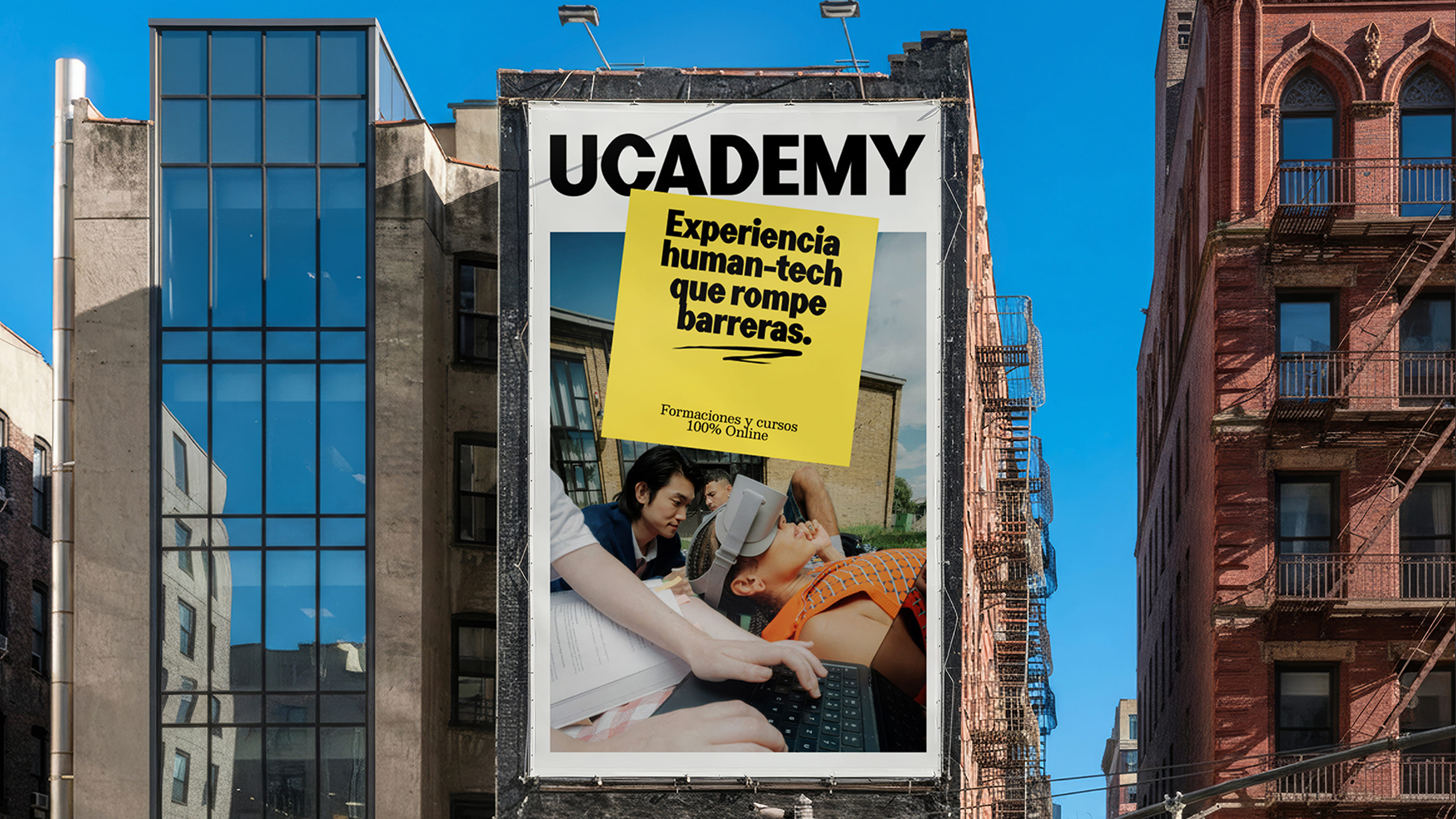
The voice of real life
The verbal identity was also built as a system. We created a common voice for the entire Ucademy universe, designed to break away from the rigidity of educational language and bring the brand to a more human, clear register connected with the reality of whoever studies.
Based on that common foundation, we developed differential resources for each vertical. Because Atlas, Explora, and Polaris didn't need to speak the same way. What mattered was that they all breathed Ucademy while sounding with precision within their own territory.
***fila***
***columna***
<video class="video-full" autoplay preload loop muted playsinline><source src="https://media.solublestudio.com/daedai8zs/video/upload/f_auto,q_auto/v1779360690/solubleweb/Ucademy_case/ucademy-sistema-marca-especializar-escalar-edtech-block-3593db1af1e280ad8b93ff341d3da76b" type="video/mp4"></video>
***columna***
<video class="video-full" autoplay preload loop muted playsinline><source src="https://media.solublestudio.com/daedai8zs/video/upload/f_auto,q_auto/v1779360690/solubleweb/Ucademy_case/ucademy-sistema-marca-especializar-escalar-edtech-block-3593db1af1e280559219cb8018428a54" type="video/mp4"></video>
***fila***
***fila***
***columna***
<video class="video-full" autoplay preload loop muted playsinline><source src="https://media.solublestudio.com/daedai8zs/video/upload/f_auto,q_auto/v1779360691/solubleweb/Ucademy_case/ucademy-sistema-marca-especializar-escalar-edtech-block-3593db1af1e280bf9953c5cbdbc26e8d" type="video/mp4"></video>
***columna***

***fila***
Identity for a Human-Tech experience
The visual identity was developed as part of the system. It had to express the character of the brand and work well in a deeply digital deployment. The concept that articulated the whole was the travel diary: a way of understanding learning as a living journey, personal and under construction. From there we built a common foundation for the entire ecosystem and enough room for each vertical to develop its own expression.
The identity was also designed to respond to real digital environment needs: color palettes prepared to coexist with interface, functional chromatic extensions, contrast criteria and accessibility checks. The logo and its variants with endorsement were also part of that logic, reinforcing coherence and approval in the launch of new brands.
***fila***
***columna***
<video class="video-full" autoplay preload loop muted playsinline><source src="https://media.solublestudio.com/daedai8zs/video/upload/f_auto,q_auto/v1779360691/solubleweb/Ucademy_case/ucademy-sistema-marca-especializar-escalar-edtech-block-3593db1af1e280a0b196ee61c7100129" type="video/mp4"></video>
***columna***

***fila***
Complete the system with movement
The animated identity completed that construction as a functional extension of the brand in digital and activation.
Each vertical could adapt that shared foundation to its own energy, always within a shared logic. Motion wasn't there to decorate, but to organize, set rhythm, and make the brand behave as a system.
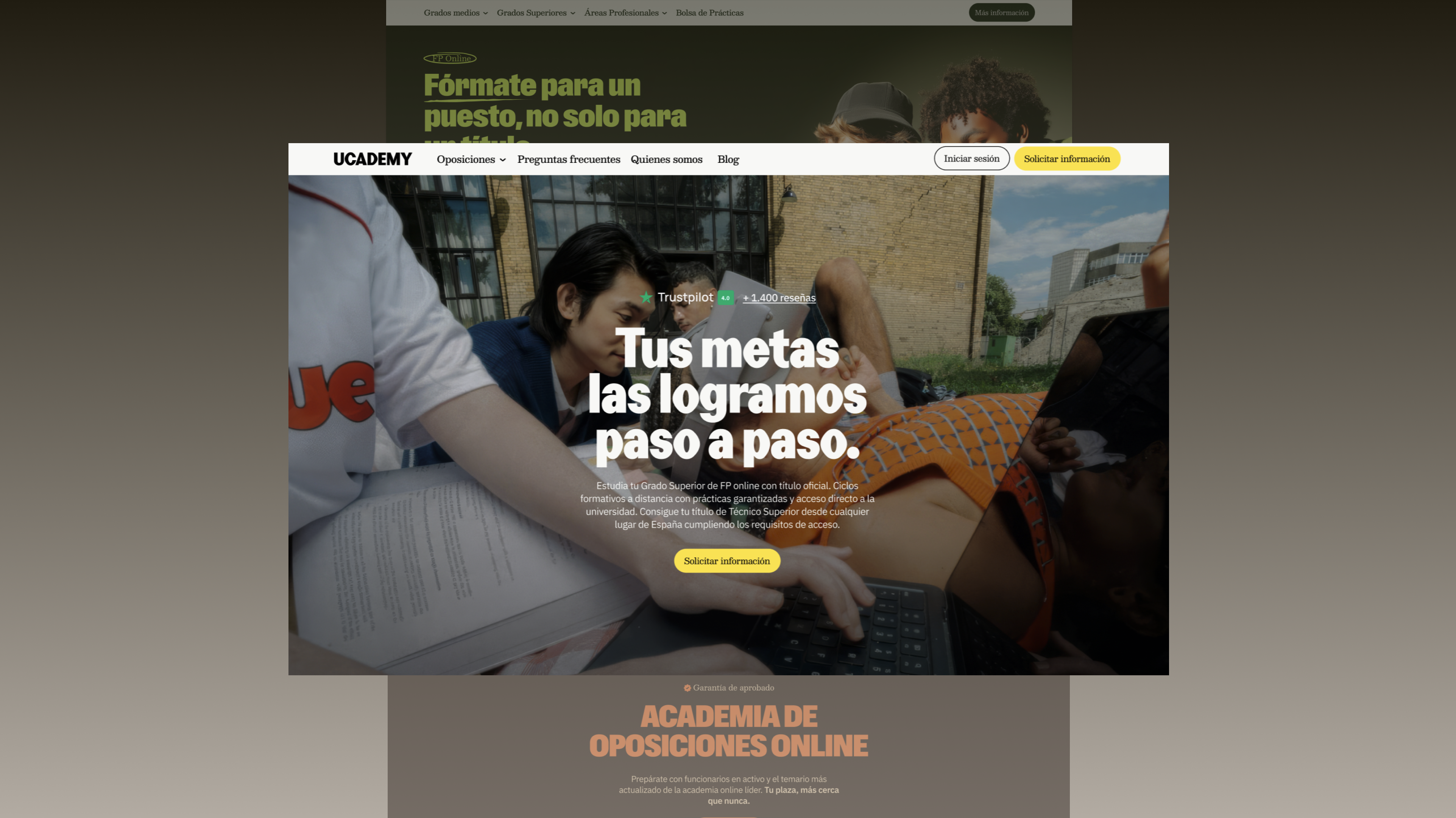
Accompanying the rollout to enable autonomy
The work didn't stop at strategy and identity. We also accompanied the team through the initial web deployment and launch. We defined the look and feel of the ecosystem's websites and designed a library of reusable components like navbar, footer, testimonials, and tables so that Ucademy and its verticals could activate the system with consistency, speed, and autonomy.
Added to that was our accompaniment as brand guardians in initial applications and in the launch strategy for new brands, to bring the system to market with coherence and criteria.
***fila***
***columna***

***columna***

***fila***
The wild map
What we built wasn't just a rebranding, but a system prepared for specialization, order, and scale. A main brand with clear vision. An endorsement model capable of transferring trust without hindering differentiation. A verbal, visual, and animated system ready to grow with coherence. And an operational foundation that enabled the team to activate that universe with more autonomy and agility.
Ucademy already had business. What it needed was structure to keep growing without losing focus. That's what we built: Ucademy's wild map.
