Job openings at Soluble
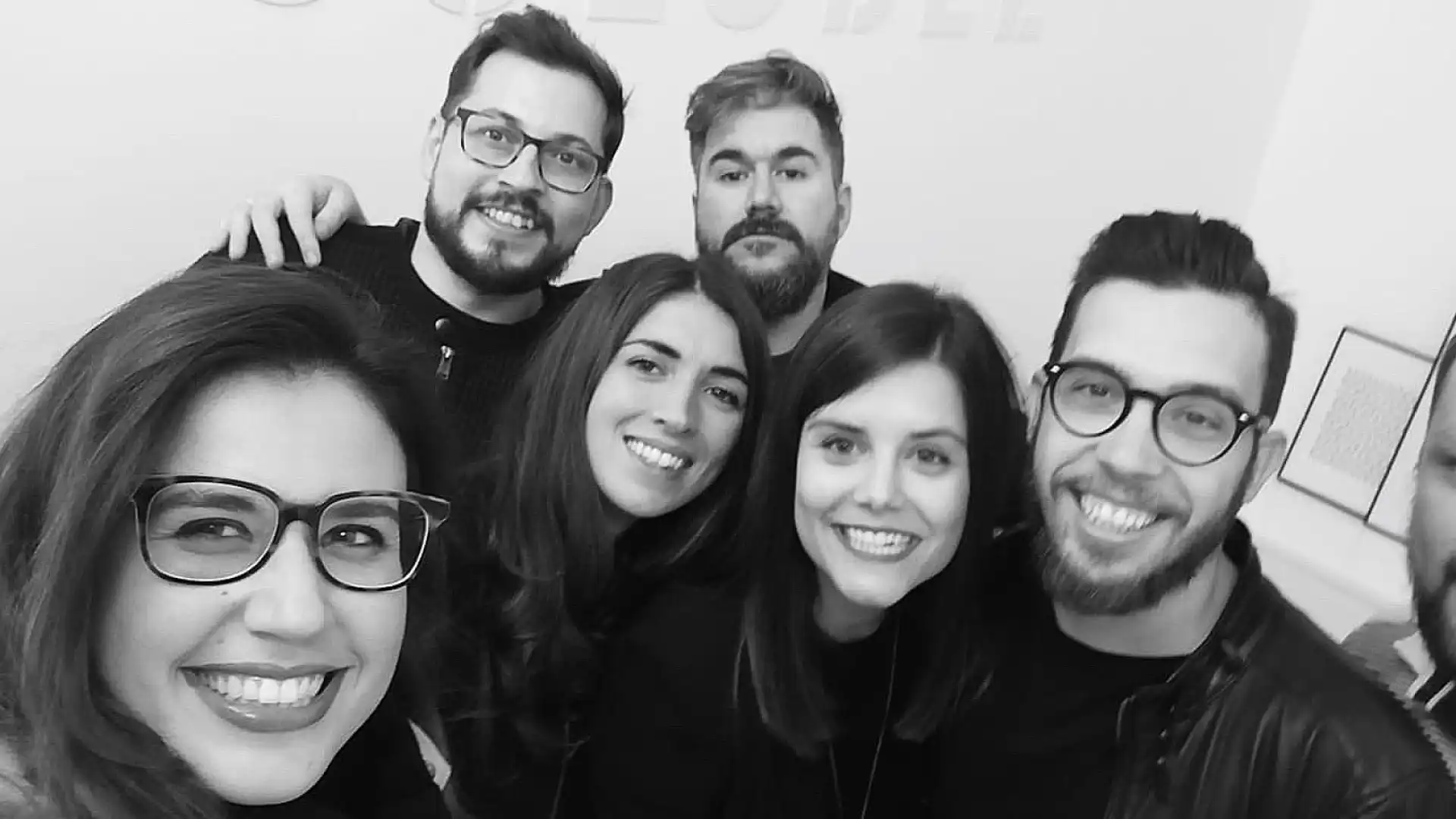
A few months ago, from Soluble Studio we published a couple of job openings to expand the team. In just a few weeks, we received over six hundred applications from people interested in the positions.
It hasn't always been like this and we think it's a good time to share our process so others can pick up ideas. Though mostly, we hope we can keep learning.
Why we're sharing this
First, out of gratitude. Finding talent is a very complicated task, especially when you've just started and have no idea how to reach your future team.
At the time, posts from Tomás Santoro in the SumaCRM Blog, as well as everything we learn from David Tomás and its management in Cyberclick or the inexhaustible Bonilista of David Bonilla. This could be our way of giving back to the community. –Special mention to Laura Carreira and the great work she did to get us off to a strong start.
- If this article helps studios, startups, and established companies reflect on their hiring processes, we'll be doubly happy.
Second, because the feedback we've been receiving through different channels—even from those who ultimately didn't land one of the positions—makes us think we're doing something right and that, at the same time, there's a lot we can improve.
And third: with this exercise we hope to organize our thoughts, document where we are right now at Soluble, and hopefully gather more feedback and constructive criticism. If this article also helps studios, startups, and established companies reflect on their hiring processes, we'll be doubly happy.
The selection process
Let's be clear: we know the process is improvable and we've identified several errors we'll correct gradually (while making new ones along the way).
This hiring approach aims to find talent beyond our circles and be attractive from the outside, while optimizing time for both the studio and the people who take the trouble to submit their application—without compromising the level of attention we'd all like to receive as professionals and as people.
This comes at a cost, of course. It requires an investment of time, resources, and ingenuity that you have to be willing to commit to. But if you start by defining what kind of company you want to build and you see the advantages of working this way, the cost is far outweighed by the value this approach delivers.
The offer
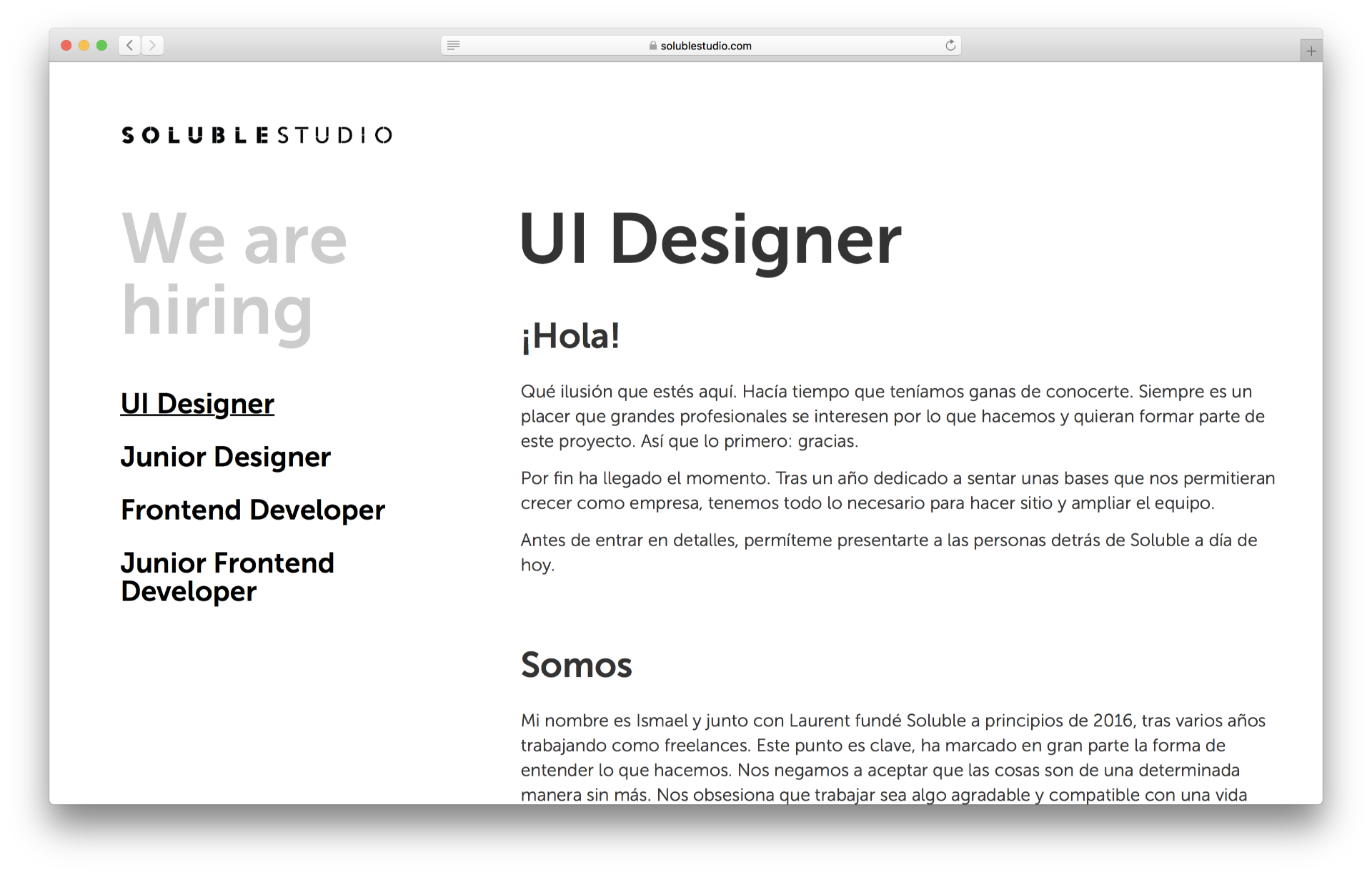
Allow me the obviousness: everything starts here. It's essential to be clear about what company and what team you want to build, but also what needs you have and what profile could help you solve them. Beyond saving time, this will make the following steps much easier.
At Soluble, this is perhaps the point we dedicate the most time to. We put care into both thinking about what we can offer and writing in a simple, honest, and direct way.
We always try to:
- Use inclusive language naturally. Fortunately, Spanish allows us to refer to our audience with infinite richness of options, and we take advantage of that to avoid repetition or classical resources. We write offers in this language because it's the common one across the whole team, though not the only one.
- Align voice, tone, and style with our verbal identity. Being a branding studio, it would be a crime not to care about what values we want to convey in the way we write. Even though different people sometimes write, it's important to try to unify what comes across from the offers.
- Make it personal. That this is about people is something we keep in mind in our day-to-day work and, as it should be, in these kinds of processes. In our latest offers, for example, we introduced the team one by one. Given the size we are, we can afford to do it.
- Study the market. Look at how others do it, learn from it, and adapt it to our context. From approach to profiles, functions, salaries—everything.
- Be as precise as possible. Getting specific saves time and is therefore a sign of respect to whoever is on the other end. We don't leave details like conditions, contract type, or salary for the last minute (even if it's an indicative but realistic range). Because yes, people work for money and that's something to factor in before investing time and energy in a hiring process.
Another key aspect is knowing where to post the job. At Soluble, what's worked best for us is having our own dedicated section on our website for all job listings and then linking them from different platforms or communities:
- Design communities on Slack like Design:ES
- Our branding Telegram channel
- The jobs section of Domestika
- Sponsorship of La Bonilista
- LinkedIn (as a post and as a standard job posting)
- Sharing on social media
The form
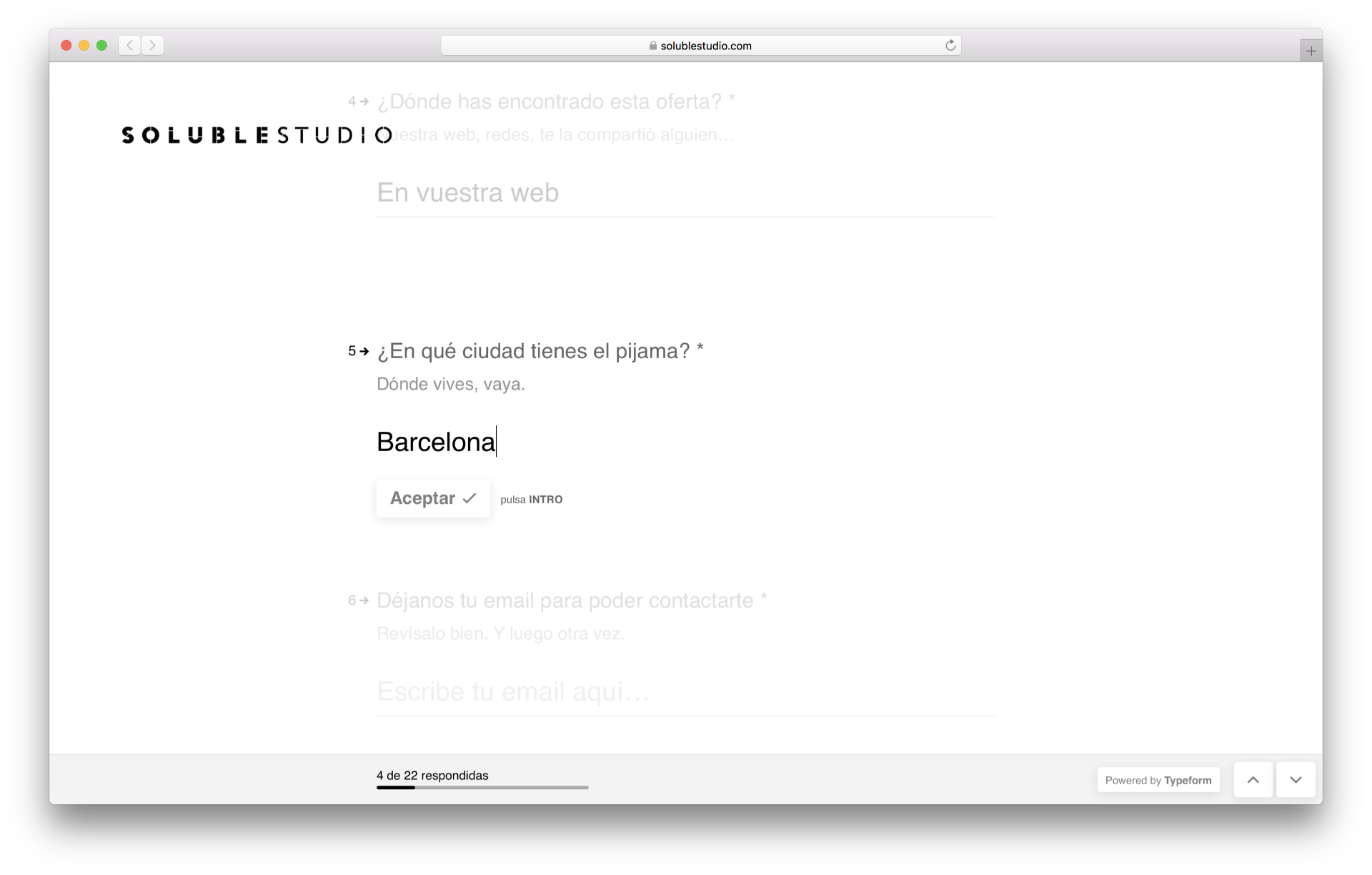
One of the aspects that works best for us is a form crafted with careful attention that's engaging while streamlining the process and serving as a first filter, since on average it takes between twenty and thirty minutes to complete (and we still receive hundreds of applications).
- A résumé? A portfolio? Neither one, or both, seem sufficient to us to know if that person could become part of Soluble.
The early postings we published before we understood how to do it correctly took an enormous amount of time to review and assess each application, and the information we received was insufficient to do so with sound judgment.
A résumé? A portfolio? Neither one, or both, seem sufficient to us to know if that person could become part of Soluble. There's also the fear of missing professionals who could work brilliantly on the team.
Starting a conversation with each person is unfeasible, and conducting a preselection based on weak criteria carries too much risk. Furthermore, if submitting an application becomes too easy, not everyone will send theirs with the same drive or intention.
The form solves all these issues at once. With it we achieve:
- Collect basic data from each application
- Filter out those willing to invest time and effort to enter the selection process.
- Get to know the person who wants to work with us in a somewhat closer way.
- Better assess whether that person is aligned with the company culture and the position we need to fill.
- Discuss attitudes, not just aptitudes.
- Make a fairer preselection of candidates with real possibilities.
- Review, without exception, every single application we receive.
And all of this, thanks to our friends (and for not long now also clients 🎉) at Typeform, in a way that allows us to automate several parts of the process and classify information through integrations with other applications like Trello via Zapier.
The call
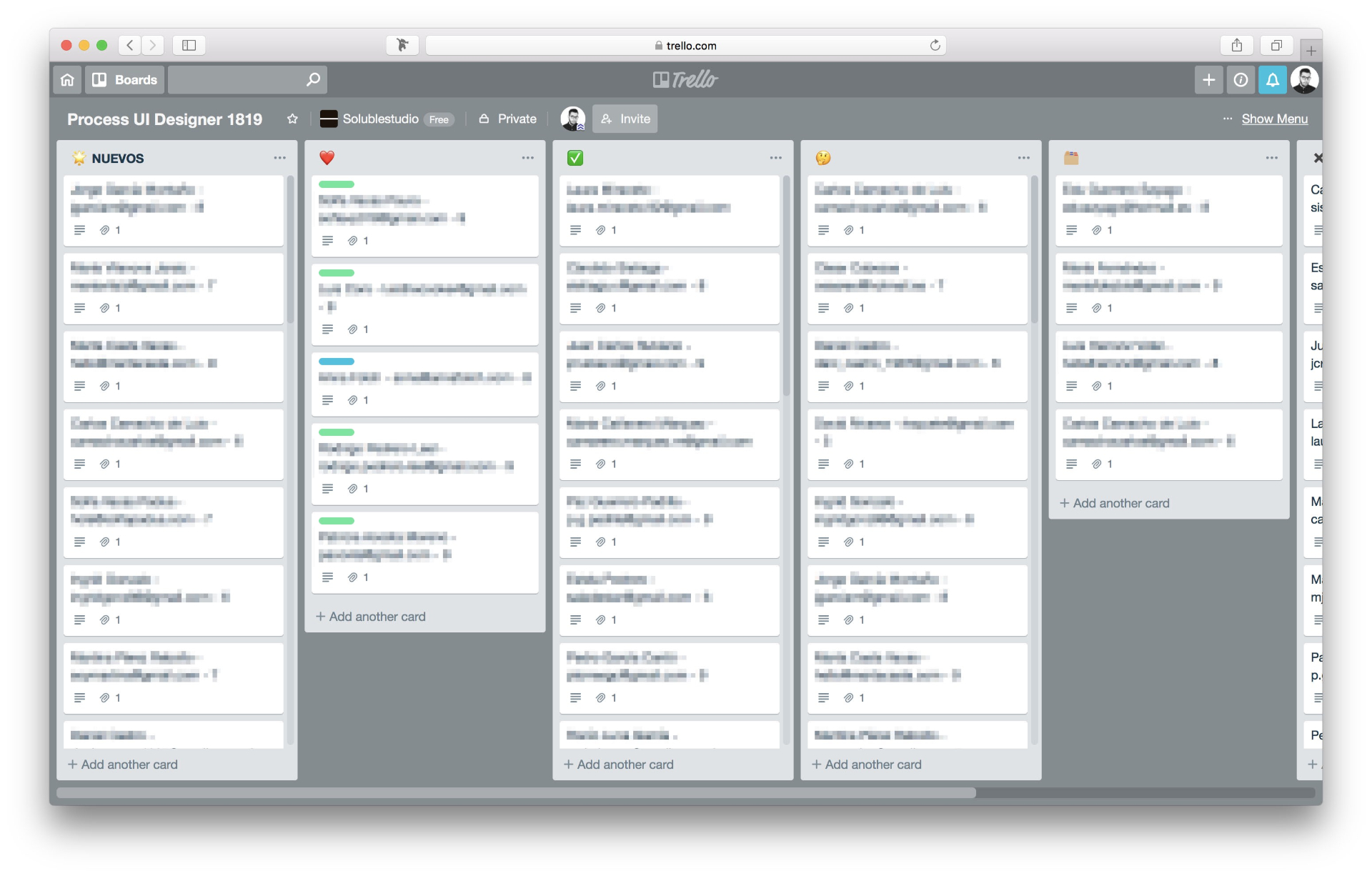
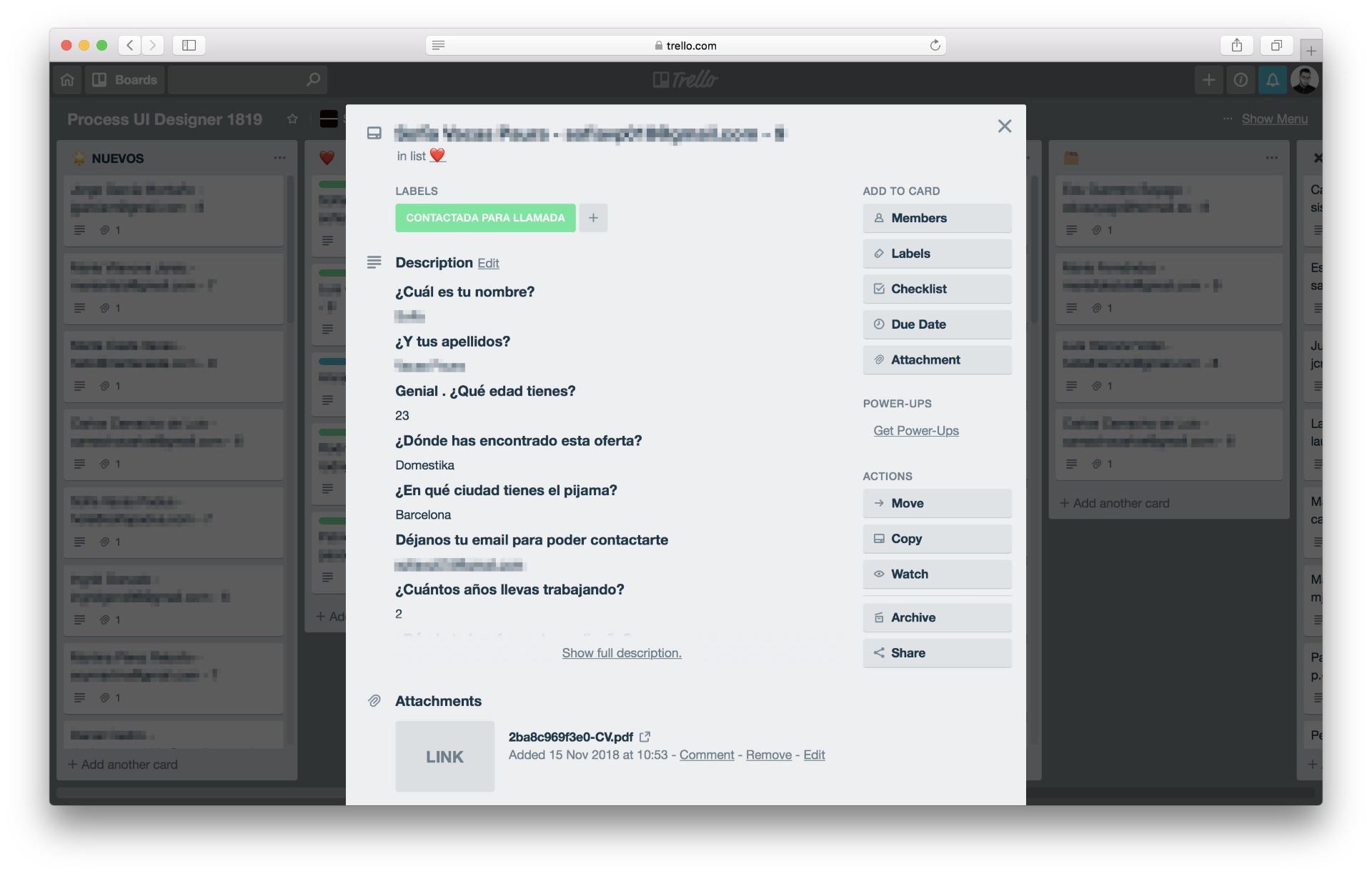
Automatically, every response to the form is captured on a card in a list on a Trello board. Every day, the team involved in the process reviews the cards that have come in and classifies them according to the criteria shown in the image above:
- 🌟 New applications.
- ❤️ Applications that have won us over.
- ✅ Very strong applications worth keeping in mind.
- 🤔 Applications that raise questions for us.
- 🗂 Strong profiles that don't fit or don't do what we're looking for right now.
- ✖️ Applications that don't match what we're looking for.
We typically establish a preference ranking that lets us tackle this third phase in rounds rather than all at once. It affects the pace of the process, especially if we don't find who we're looking for in the first batch, but in exchange we make hiring compatible with day-to-day operations without needing a dedicated team for it exclusively.
With all the work we've put into the first steps, at this point we have plenty of data about who we're going to find on the other end of the phone.
- A call that typically doesn't run longer than 10 minutes and gives us the key to understanding what they're looking for and whether it makes sense to bring that person into the next phase.
Again, with the goal of optimizing the time everyone involved dedicates to the process, we designed a call based on a chapter from the book "The Happiest Company in the World", by David Tomás, where we try to gauge the degree of involvement and affinity that might exist.
In this call, we ask:
- What does your current work entail? We already know where you work and what your position is, but nowadays in this sector it's hard to know what someone does based on just that information.
- Why do you want to change jobs? We're looking not just for reasons but also the context in which you're job hunting: whether your company knows about it, whether you're actively searching, whether you're in multiple processes…
- Why do you want to work at Soluble? Critical. It's clear that the entire process is focused on finding that person who sees in Soluble a long-term relationship. This is a project built on the people who make it possible, and we want it to stay that way.
- How much would you like to earn? Boom. Let's cut to the chase. The sooner we agree on this, the better. We've stated in the offer what we have in mind to pay, but we want to know what the other party expects.
It's a call that typically doesn't last more than 10 minutes and gives us the key to understanding what they're looking for and whether it makes sense to bring them into the next phase.
The test
We hate tests. But from experience we know they're genuinely useful in some cases. When we have no choice but to validate someone's skills, we propose a test during the phone call.
This test, for both developers and design profiles, has certain characteristics that make us feel less bad about proposing it:
- It has a maximum time commitment of two hours.
- The exercise is completely fictional—it's not a past, present, or future Soluble project.
- It's meant to be something enjoyable to do in terms of subject matter and approach.
We schedule a day and time that works for the person to dedicate a maximum of 120 consecutive minutes to the test. At that point, we send a link to a folder where everything needed for the exercise is located: instructions, resources, etc.
After a maximum of two hours, whatever has been completed must be in the same folder so we can assess the work.
The evaluation criteria depend on the profile we're looking for, but we always take into account the context in which the activity takes place. It's one more data point to inform our decision when the time comes. Generally, it's not usually decisive in determining whether to move forward or not in the process.

The interview
This is perhaps one of the areas where we have the most room for improvement. It was the first thing we defined and hasn't gone through many iterations yet. The previous phases are so intense that what matters most here is assessing the personal fit.
We invite those whose test results impressed us in the study to experience the workspace: the location, the atmosphere, the light, and the vibe that breathes through the office.
We typically interview two people from the team, who vary depending on the profile we're hiring for, just as the questions we ask vary. We don't usually interview more than three people per round in each process. And one round is usually not enough.
We could structure the interview by sections:
- Candidate presentation. We ask about both academic and professional background, picking up from the phone conversation we had and diving deeper into the answers.
- What they know about Soluble. We expect them to do their homework and be able to talk about us before we pitch to them. It's very easy to see who's done their research and who hasn't.
- Soluble presentation. Our story. This is the moment to inspire and convey all the strengths of the project. We talk about current and future projects, our beginnings and where we're heading.
- Questions about skills. They vary depending on the profile. We want to know what the person sitting across from us knows that relates to the functions they'll have to perform on the team.
- Questions about attitudes. A moment for a warmer rapport. We want to know the person behind the professional profile. Interests, concerns, plans, preferences, fears…
- Present and future at Soluble. Questions revolving around the possibility of the person being hired. How and where they see themselves, how they think the first days will be, what their expectations are…
- Questions and closing. Finally, we're the ones who field questions and wrap up with practical matters about timelines, current situation, next steps, etc.
With all this, we have enough material for whoever conducted the interview to know who (usually a maximum of two) could join the team.

The coffee
We added this step at the beginning of last year and it's been working out really well: the whole team (or almost) grabs a coffee with whoever will probably become part of Soluble.
We do it outside the studio, at the bar downstairs. The relaxed setting lets us see new sides of the person who's made it this far, and although we know it can be intimidating or even overwhelming, it helps both sides get to know each other a bit better.
It's usually a courtesy step for both the candidate and the team. We value every team member's opinion and what they see in who could be their new colleague. If everything's gone well (so far there hasn't been a single case where it hasn't), we'd move to the next phase.
The offer
With all these ingredients, we finalize the specific offer for that person who has been validated by the team.
Salary, conditions, contract clauses, start date, and any other details that haven't been finalized yet.
The offer is usually communicated more quickly, by phone and then in writing or a similar format. After that, we give them a few days to think it over and give us an answer.
The answer
The day we usually look forward to most on the team. There have been so many validations and alignment has reached such a point that we rarely get surprised at this stage.
If what we propose is rejected, we'd go back to the person who came next in the process or, depending on the case, it could mean starting almost from scratch again. Another weak point in our process.
If they accept, we formalize the contract and try to have a team event before they join so that the first contact (or second actually) happens outside a normal workday.
The closing
The point that's given me the most headaches and taken the longest to find a solution for.
When I was freelance and daydreaming with who is now my partner about starting our own company, I was crystal clear that when I hired, I'd keep everyone informed of the process and, when it came time to say no, I'd face that uncomfortable moment rather than leave anyone without an answer.
The reality is it's incredibly hard to respond to every application and it wasn't until this last process that we've been able to fulfill that commitment (apologies here to everyone before). For several reasons.
- First, it's a purely operational issue. It takes time (a lot of it), organization (more), and dedication—something in short supply especially when you need to hire new profiles.
- Second, because you never know if the process will end well or if you'll need to pull from contacts who weren't in the top spots. Plus, there's not always crystal clarity about someone.
- And third because frankly, it's a pain to tell someone no when they've put time and hope into submitting their application.
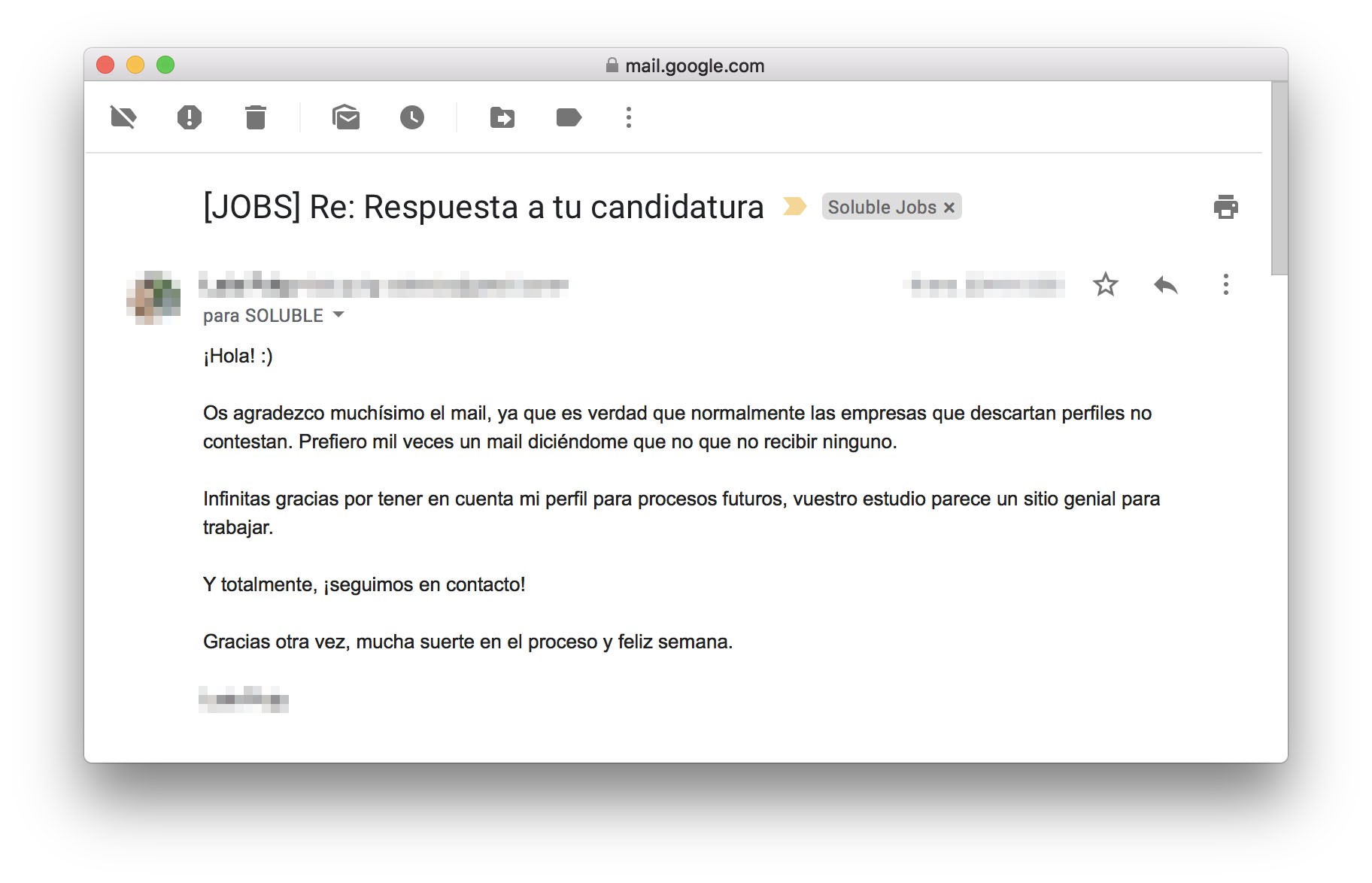
Thankfully, today I can say we've responded to 99% of the people who filled out the form (everyone except those who did it in the last few days, which is already over 700). And we'll respond to all of them.
The responses to these emails couldn't have surprised us more, while also encouraging us to keep wrapping up the process this way.
Onboarding
Another area we're working on and need to improve is the onboarding process for new hires.
Right now, we have a modest welcome pack, a team breakfast, and meetings with the people involved in the workflow of the newly hired profile to bring them up to speed on projects and gradually define their responsibilities.

The secret to making this work
Undoubtedly, following this process has helped the team we're building (we'll have doubled in size in just six months) function at its best on every level.
But you can't lose sight of the fact that this is just one piece of the puzzle. One more element of the system that is our brand. More important than the process itself are the values that emerge from it and what you can read between the lines about what matters to us.
There's much we can improve, and we'd be delighted to hear your feedback and ideas to address the weak points in this approach. That said, for now, all of this has served me to work surrounded by people I admire at every level and who help me grow personally and professionally every day.