Is your brand doing wackaging?
One of the key moments when building a brand's identity is defining its verbal identity. The brand's culture and strategy need to be perceived in how it speaks and writes, thus forming part of its identity.
Verbal identities, just like visual ones, don't escape trends and fads. Moreover, they suffer from that bias in which we believe that by replicating the conditions of others, we'll get their same results: a kind of cargo cult verbal.
In recent years, quite a few brands have decided to use a verbal identity that we could describe as innocent, naïve, or excessively approachable. It's true that it's nice to see how many brands are getting closer to their audiences by leaving behind overly corporate and top-down messaging, but perhaps it's been overdone. This verbal tone has been so excessive that they even gave it a name in English: wackaging. The term was coined by journalist Rebecca Nicholson on her Tumblr (sadly defunct) dedicated to highlighting this type of verbal communication. Today you can find multiple examples by searching Twitter for the hashtag #wackaging or r/wackaging on reddit.
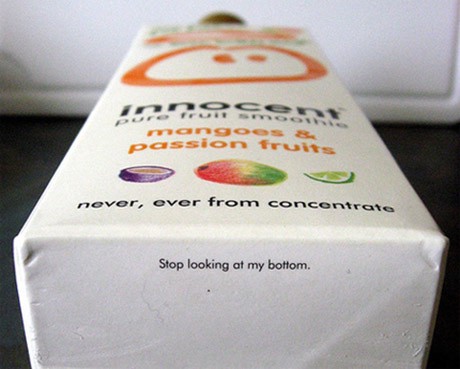
Wackaging in innocent packaging
The wackaging can be understood as the equivalent to blanding in visual identity. That excess of making a brand's identity something extremely close, familiar, and talkative. Something that, moreover, may not be backed by an actual culture of the brand itself, but by a style that's trending. The term wackaging kicked off by Nicholson to define the verbal tone of the Innocent smoothies brand used in the texts on the packaging of its juices.
An example of Innocent on one of its juices:
- "Bananas for thickness and sweetness and strawberries for pretending to be posh — a winning combination. And that 'blush pink' goes very nicely with your lipstick. Say no more."
Which in Spanish they use as:
- "Los plátanos te dan energía y las fresas la sonrisa. Además, este smoothie de color rosa pálido va muy bien con tu barra de labios del viernes pasado. Sí, no digas nada más, te vimos."
The term wackaging has transcended packaging to reach any point of contact, physical or digital, where the brand expresses itself with too much intimacy. Perhaps the clearest example in Spanish is Mr. Wonderful, which has defined a very personal style imitated to death. Messages like: "[…] a free postcard to tell them loud and clear that you love them infinitely" reflect what wackagingis. In Barcelona there are also the chic&basic hotels as an example of this tonal verbal voice.

The chic&basics hotels and their welcome packs
Why can this verbal tone provoke rejection in brands? Is it just a matter of audience saturation? Why is it more present in the food or health territory? In my view, rejection happens when it feels forced or in contexts that lack flexibility. That is, that tone works differently in a juice brand than in a tonic brand or, of course, in an alcoholic beverage. That it's more prevalent in food is a result of the cutthroat competition that happens between packages on a supermarket shelf. It's an environment more conducive to this type of messaging. There's also a kind of breaking of "the fourth wall" when brands address you so directly that it can provoke a certain bewilderment or distrust in some audiences.

When your soap tries to get you in the mood
On the other hand, this feel-good and innocent tone is more typical of US or British contexts than European ones, which provokes rejection in Mediterranean countries for feeling decontextualized and forced. Even certain audiences can feel treated in a disrespectful or infantile way in some cases.
This is a clear example of a brand failing to connect with a user due to an excess of "sense of humor" in its communication (turn up the volume):
The wackaging is not something new; in fact, it had its heyday around 2013, but trends always come back and you're starting to notice a certain uptick in innocent and naïve communication in some product and digital service brands that didn't experience the moment of maximum exposure of this phenomenon. Here's an example:
In my view, a brand that has managed to pull off innocent communication with freshness, but without being cheesy, is Lush. That is, to a certain extent because it's managed to channel that more personal side through its employees, both those who create its products in the lab and those in store, achieving that brand voice closeness without having to do it "herself" directly.
Some examples of Lush's communication:
In short, while expressing yourself positively can generate benefits in your brand's impact, assess carefully whether it's coherent with your value proposition and whether the brand isn't trying to be funny instead of actually being it. Most importantly, reflect on whether your brand is just telling a story or whether it's actually living it, because if all you have is "storytelling," you might have a problem.